Temple of Hercules
Temple of Hercules
A 2nd-century Roman vestige commissioned by Marcus Aurelius, the Temple of Hercules overlooks Amman from the Jabal al-Qal'a citadel, at 800 meters above sea level.
Perched at over 800 meters above sea level on the hill of Jabal al-Qal'a, the Temple of Hercules dominates the historic center of Amman. A 2nd-century Roman vestige, it stands as the centerpiece of the citadel, one of the most visited archaeological sites in the Jordanian capital.
Why visit the Temple of Hercules
The site offers three compelling reasons. First, its location: Amman's citadel, or Jabal al-Qal'a, commands panoramic views from its 800-meter altitude over the lower city, the ancient theater, and surrounding hills. Second, its archaeological significance: it is Amman's most imposing Roman vestige, its scale making it one of the region's most ambitious religious structures. Finally, its inclusion in the Jordan Pass, which facilitates access during a combined visit to Amman, Petra, and the country's fortresses.
History of the site
The hill now home to the temple has been inhabited since the Bronze Age. It corresponds to the ancient Kir-Moab mentioned in the Old Testament, a stronghold of the Ammonites. Several civilizations succeeded one another here: Assyrians, Persians, Greeks, Romans, and Byzantines, each leaving their own mark. This layering explains why the plateau's original structure has largely vanished.
The Temple of Hercules itself dates to the 2nd century CE. It was commissioned between 161 and 179 by Emperor Marcus Aurelius, at a time when Roman worship was expanding into the Near East. According to archaeological estimates, the structure should have risen to approximately 15 meters in height. The absence of pillars around its entire perimeter suggests, however, that construction was never completed.
What to see on site
The temple ruins
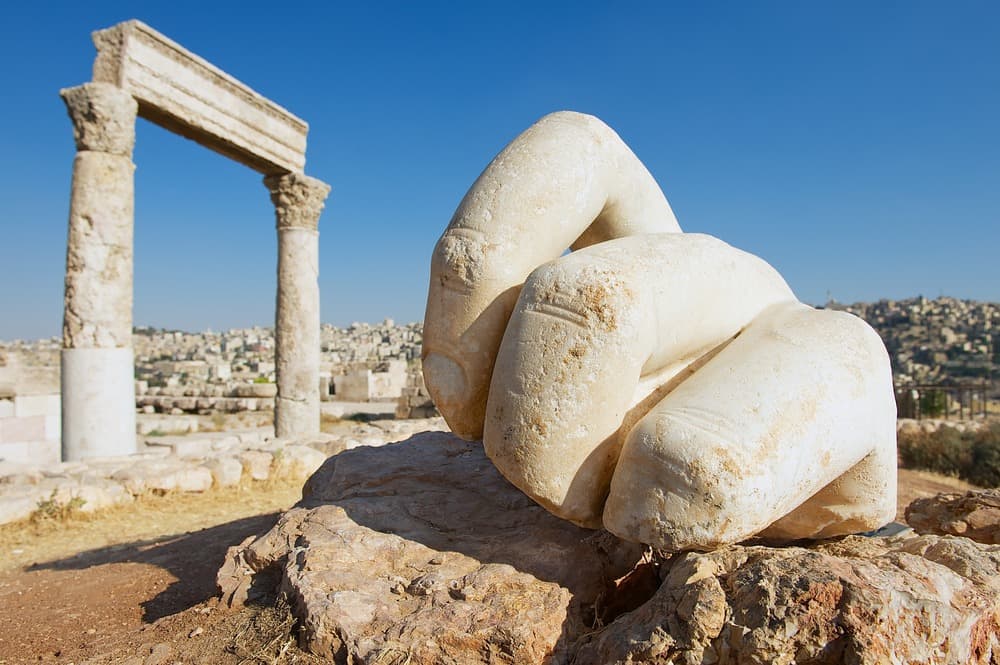
The portico preserves six pillars: two remain intact and reach about ten meters high, while four are partially collapsed. At the base of the structure rest three fingers of a colossal statue of Hercules. Their scale hints at a monumental effigy of the demigod, whose total height likely exceeded that of the pillars themselves.
An original scale model of the temple is displayed at the American Center of Oriental Research (ACOR) in Amman for those wishing to visualize the building in its presumed original state.
The Umayyad Palace
A short distance from the temple stands the Umayyad Palace, an Arab-Islamic architectural complex from the 7th and 8th centuries. It comprises an audience hall crowned with a reconstructed dome and an underground cistern that served as a water reservoir during dry periods.
The Byzantine church and museum
Within the citadel's walls, the ruins of a 6th-century Byzantine church border the visitor path. The Jordan Archaeological Museum, located on the same site, houses artifacts spanning several millennia of regional history.
Practical information
Plan approximately 1.5 to 2 hours to explore the entire citadel, temple included. As the site is outdoors with limited shade, bring a hat, water, and closed-toe shoes. The best lighting for photography occurs late afternoon, when low-angle sunlight highlights the pillars and limestone. Admission requires a ticket at a moderate rate for foreign visitors covering all citadel attractions. Entry is free for Jordan Pass holders. Opening hours vary by season, with extended hours in summer compared to winter, and Friday hours are offset; verify current times before your visit.
How to get there
The citadel sits atop Jabal al-Qal'a, directly overlooking Amman's city center. From the historic center district or near the ancient theater, the uphill walk is possible but steep, via stairs and narrow streets; allow 20 to 30 minutes depending on your pace. Taxis are the simplest option: they drop visitors directly at the site entrance for a short fare. Rideshare apps also operate in the capital.
Nearby attractions
Coming down from the citadel, Amman's ancient theater, carved into the hillside and able to accommodate nearly 6,000 spectators, merits a stop. In close proximity are the Roman odeon, the monumental fountain (Nymphaeum), and forum remains.
To extend the archaeological itinerary beyond Amman, several sites complement your discovery of Roman and medieval Jordan: the Ajlun Fortress, the Machaerus Fortress, and Al-Karak Castle.
Frequently asked questions
Frequently asked questions
Yes. Entry to Amman's citadel, which includes the Temple of Hercules, the Umayyad Palace, the Byzantine church, and the archaeological museum, is covered by the Jordan Pass.
Allow 1.5 to 2 hours to fully explore the citadel, including the temple, Umayyad Palace, Byzantine church, and archaeological museum.
As the site is outdoors with limited shade, spring (March-May) and autumn (September-November) offer the most pleasant conditions. In summer, favor early morning or late afternoon.
On foot via stairs from the historic center (20-30 minutes of steep climbing) or by taxi for a short ride that drops you at the site entrance.
Six pillars of the portico, two of which remain intact at about ten meters high, plus three fingers of a colossal statue of Hercules. The original structure should have reached approximately 15 meters in height.
Extend your visit through Jordan
The Temple of Hercules naturally fits into an itinerary through ancient and medieval Jordan, between Amman, Jerash, the Dead Sea, and the Wadi Rum desert. To build a coherent trip around these sites, explore our Jordan journeys.
Interested in this visit?
We can include it in your personalised itinerary.