Machaerus Fortress
Machaerus Fortress
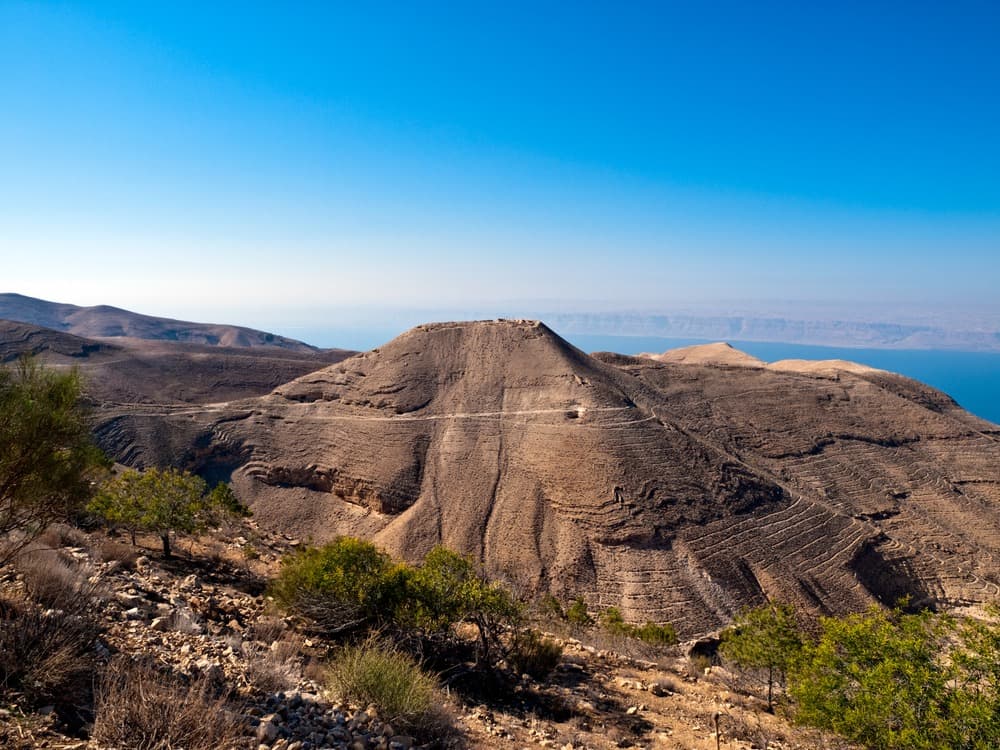
Perched at 1,100 m overlooking the Dead Sea, Machaerus fortress preserves the remains of the Herodian palace associated with the execution of John the Baptist.
Perched on a rocky peak at approximately 1,100 meters in elevation, Machaerus fortress dominates the Dead Sea and the Jordan Valley. This major archaeological site in Jordan, located near the village of Mukawir and about forty kilometers southwest of Madaba, preserves the remains of a Hasmonean palace-fortress rebuilt by Herod the Great. Christian tradition places the imprisonment and execution of John the Baptist here.
Why visit Machaerus
Three main reasons warrant the journey. First, the site offers one of Jordan's broadest perspectives over the Dead Sea and the western bank of the Jordan River; on clear days, the hills of the West Bank are visible. Second, Machaerus holds genuine archaeological interest: the Doric and Ionic columns restored through anastylosis provide a concrete sense of the architecture inherited from Herod. Finally, visitor numbers remain modest compared to Petra or Jerash, allowing for a peaceful experience.
The site also fits naturally into a coherent biblical itinerary around Madaba, between the Church of Saint George with its mosaic map, Mount Nebo, and the baptism site on the Jordan River.
History of the fortress
Construction is attributed to Alexander Jannaeus, Hasmonean ruler of Judea, around 90 BCE. The young kingdom of Jerusalem, freed from Seleucid control, had to contend with a hostile regional environment: Nabataeans, Ptolemaic Egyptians, and later Romans. The dominant position of the peak served an obvious military function, complemented by a palatial role.
In 57 BCE, the Roman general Gabinius, Pompey's lieutenant, sacked Machaerus. The fortress was subsequently restored by Herod the Great following the fall of the Hasmoneans. Herod made it both a royal residence and a stronghold of the eastern frontier, equipped with reinforced walls, towers, a palace, and a sophisticated hydraulic system.
Upon his death, the domain passed to his son Herod Antipas, tetrarch of Galilee and Perea. It was here, around 26 CE, that John the Baptist was allegedly imprisoned, held for approximately two years before being beheaded at the tetrarch's order. The account appears in three synoptic gospels (Mark, Matthew, Luke) as well as in the writings of the Jewish historian Josephus, who explicitly locates the event at Machaerus.
The site subsequently fell to Herod Agrippa I. Upon his death in 44 CE, Rome reasserted direct control over the region. During the First Jewish-Roman War, Jewish rebels seized the fortress; in 71-72 CE, the legions under Lucilius Bassus besieged and dismantled it. The ruins remained forgotten for nearly two millennia thereafter.
Modern excavations began in the 1960s under American and Franciscan institutions and continued through the 1980s. More recently, the Hungarian Academy of Arts conducted, in partnership with Jordan's Department of Antiquities, a restoration program using anastylosis, a technique involving the reassembly of original elements found on site.
What to see on site
The fortified enclosure formed a rectangle approximately 100 by 60 meters (328 by 196 feet), flanked by three watchtowers on each side. At its center stood the Herodian palace, several elements of which remain discernible:
- The triclinium, a columned reception hall, identified by archaeologists as the probable location of the banquet described in the gospels.
- The private apartments and courtyard, which structured the residential section.
- The thermal complex, evidence of the refinement of the Herodian court.
- The cisterns, connected to an elaborate rainwater collection system essential in a desert region.
- The Doric and Ionic columns recently restored, which provide vertical reference points to a largely leveled site.
From the summit, the view encompasses the Jordan Valley, the Dead Sea, and beyond, the highlands of the West Bank. The contrast between the mineral aridity of the plateau and the blue mirror of the Dead Sea explains much of the appeal of the journey.
The episode of Salome, who allegedly obtained the Baptist's head following her dance, has nourished extensive cultural resonance: Oscar Wilde's play Salomé (1891), the opera by Richard Strauss derived from it (1905), and evocations by Flaubert and Mallarmé.
Practical information
The site is open daily, generally from late morning until sunset; hours vary by season, so it is best to verify locally before departing. Entrance is charged at a modest rate, and access is free with the Jordan Pass, which makes inclusion of the site in a Jordanian itinerary virtually automatic for visitors holding the pass.
Plan for approximately 1.5 to 2 hours on site, including the climb. From the parking area, a maintained path ascends to the summit: wear good shoes, bring water, and wear sun protection, as shade is virtually nonexistent. The site is challenging for those with significant mobility restrictions due to the elevation change.
When to visit
The best periods are spring (March to May) and autumn (September to November). Temperatures are manageable and the light, particularly sharp in late afternoon, enhances the view over the Dead Sea. Summer is very hot on the exposed plateau, and winter can bring rain, fog, and cold wind liable to obscure the panorama. For photographers, aim for late afternoon: low-angle sunlight accentuates the relief of the ruins and colors the Jordanian depression.
How to get there
Machaerus is located in the immediate vicinity of the village of Mukawir, about 2 km away. From Madaba, count approximately forty kilometers by road, amounting to nearly an hour's travel due to the terrain. From Amman, plan for roughly 1.5 to 2 hours by road via Madaba.
- Rental car: the most straightforward option; the road is well signposted from Madaba.
- Taxi: negotiate a round trip with waiting time from Madaba or Amman.
- Organized excursion: many operators include Machaerus in a full day combining Mount Nebo and Madaba.
- Public bus: possible but infrequent, suited to independent and flexible travelers.
Nearby attractions
The Madaba region concentrates several sites complementary to Machaerus:
- Madaba and the Byzantine mosaic map of the Church of Saint George.
- Mount Nebo, the traditional vantage point from which Moses viewed the Promised Land.
- The baptism site of Bethany Beyond the Jordan.
- Further south, the Karak Castle, a major Crusader fortress.
- To the north, the Ajlun Fortress, a medieval Islamic complement to Jordan's castle landscape.
Frequently asked questions
Frequently asked questions
Yes, provided you allocate a half day. The site combines archaeological interest, biblical significance, and one of the country's finest panoramas over the Dead Sea. It integrates naturally into a Madaba – Mount Nebo – Machaerus circuit.
Yes, entrance to Machaerus is covered by the Jordan Pass, making the visit free for pass holders.
Plan for 1.5 to 2 hours, including the climb. The ascent from the parking area to the ruins takes approximately twenty minutes on foot depending on your pace.
The historian Josephus explicitly locates John the Baptist's imprisonment and death at Machaerus. The synoptic gospels recount the episode without naming the location. The identification of the Herodian triclinium is now widely accepted.
With difficulty. A few buses serve Mukawir from Madaba but their frequency is low. Rental car, private taxi, or organized excursion remain the most practical options.
Preparing your visit
Machaerus fits logically into a broader Jordanian itinerary combining ancient heritage, biblical sites, and desert landscapes. To build a coherent route, consult our suggestions for travel in Jordan.
Interested in this visit?
We can include it in your personalised itinerary.