Roman Theatre of Amman
Roman Theatre of Amman
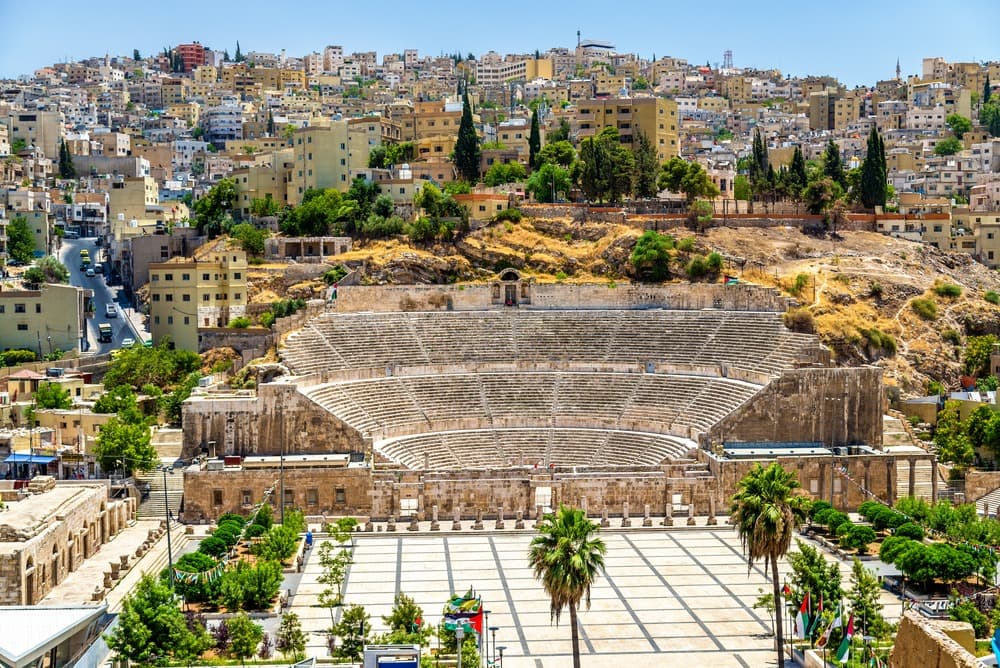
Built in the 2nd century under Antoninus Pius, Amman's Roman theatre features 6,000 seats carved into the slopes of Jabal Al-Joufah, facing the citadel.
Set against the slopes of Jabal Al-Joufah, facing the citadel of Amman, the Roman theatre displays its concentric tiers at the heart of Jordan's capital. Built in the 2nd century under Emperor Antoninus Pius, it could accommodate some 6,000 spectators and stands today as the most visible ancient remnant of the former Philadelphia, a city of the Decapolis.
Why visit the Roman Theatre of Amman
The monument offers multiple points of interest. From an archaeological perspective, it is the largest surviving Roman theatre in Jordan, with a capacity of roughly 6,000 seats and a social hierarchy readable in the arrangement of the tiers. Architecturally and urbanism-wise, its setting on Hashemite Plaza makes it a central landmark, articulated with the nearby Odeon and the nymphaeum fountain. Beyond that, the site is far more than a frozen backdrop: it houses two ethnographic museums and welcomes cultural events during the warmer months, extending the visit well beyond purely archaeological circuit.
History of the theatre
The theatre was erected during the reign of Emperor Antoninus Pius (138–161 CE). An epitaph carved into one of the building's Corinthian pilasters confirms this dating. Amman was then known as Philadelphia and formed part of the Decapolis, a federation of Hellenistic and Roman cities in the region.
The builders positioned the structure at the foot of Jabal Al-Joufah, exploiting a natural slope to carve out the seating tiers. A notable feature: the façade faces north, an orientation generally interpreted as a means of shielding spectators from the sun during performances.
The monument underwent comprehensive restoration in 1957. This work stabilized the structure and restored clarity to the ensemble, though not all original materials were preserved, which somewhat undermines the architectural authenticity visible today.
What to see on site
The tiers and social hierarchy
The arrangement of seats reveals much about the social organization of the Roman city. Local notables and potentates occupied the lower rows, closest to the stage. Soldiers responsible for maintaining order were stationed at the intermediate level. The common people took their places on the upper tiers. This hierarchy remains perceptible as you traverse the flights of stairs.
The Athena Sanctuary
A central platform once housed a sanctuary dedicated to the goddess Athena, whose cult was widespread in Philadelphia. The icon that stood there is now preserved in the Museum of Jordan, on the citadel hill. This detail reminds us that in the Decapolis, games and performances coexisted with religious practices.
The adjoining museums
The complex houses two ethnographic institutions: the Museum of Popular Traditions and the Folklore Museum. Costumes, jewellery, furnishings and reconstructed domestic scenes offer a valuable glimpse into traditional Jordanian culture, complementing the purely ancient character of the site.
Practical information
- Admission: modest entry fee for visitors without the Jordan Pass; free for Jordan Pass holders. The ticket grants access to the theatre and both adjoining museums.
- Duration: allow 1 to 1.5 hours for the theatre and museums.
- Comfort: closed-toe shoes recommended; the tiers are steep and uneven.
- Events: concerts on the plaza during the warmer months, and occasional hosting of Amman's book festival as well as public ceremonies. Check the local programme.
When to visit
The theatre is open year-round, with extended hours in summer compared to winter, and reduced access on Friday due to prayer. Morning remains the most pleasant time: the light enhances the stone, summer heat is more bearable, and crowds are lighter. Late afternoon, with its low-angle light, suits photography. Spring (March–May) and autumn (September–November) offer the mildest climate for traversing the tiers.
How to get there
The theatre sits on Hashemite Plaza, in Amman's historic centre, at the foot of Jabal Al-Joufah. From most districts of the capital, a taxi remains the most direct and economical option. Local buses serve the city centre, within a few minutes' walk of the site. On foot, the theatre connects easily to a climb toward Amman's citadel, which overlooks the plaza.
Nearby attractions
On the plaza itself, the Odeon reproduces the grand theatre's form at smaller scale, and remnants of the nymphaeum, an ancient monumental public fountain, lie just steps away. Climbing the hill, the Temple of Hercules and the citadel complex naturally extend the visit. To broaden your Jordanian circuit, St. George's Church and Ajlun Fortress rank among complementary stops in the country's north.
Frequently asked questions
Yes. Access to the theatre and both adjoining museums (Museum of Popular Traditions and Folklore Museum) is covered by the Jordan Pass. Without the Jordan Pass, entry remains at a modest fee, payable on site.
Budget roughly one hour to traverse the tiers and stage area, plus an additional 30 minutes if you wish to visit the ethnographic museums housed within the complex.
Early morning, upon opening, to avoid summer heat and enjoy lighter crowds. Late afternoon works well for photography thanks to the low-angle light on the stone.
The theatre could accommodate roughly 6,000 spectators, distributed across concentric tiers according to strict social hierarchy: notables at the bottom, soldiers in the middle, common people above.
Yes, occasionally. Concerts and cultural events are staged there during the warmer months, and the plaza sometimes hosts Amman's book festival. Check the programme locally or contact the tourism office.
To incorporate Amman's Roman Theatre into a broader itinerary blending ancient sites, desert castles and Wadi Rum landscapes, explore our journeys through Jordan.
Interested in this visit?
We can include it in your personalised itinerary.