Al Khazneh
Al Khazneh
A Nabataean facade carved into rose-colored sandstone at the exit of the Siq, Al Khazneh is Petra's most emblematic monument. A guide to its history, observation and visiting.
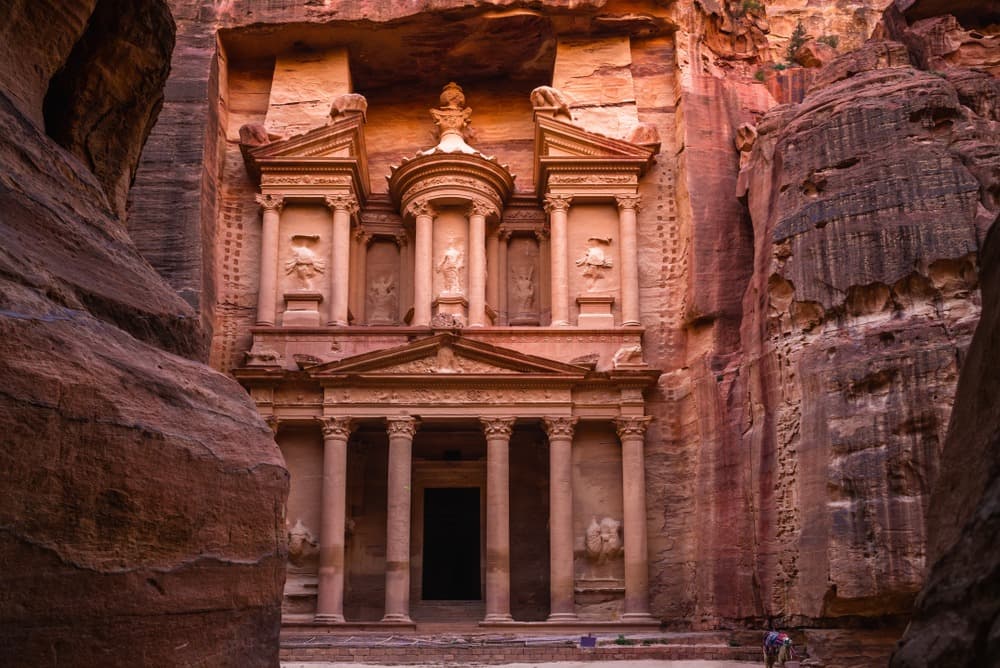
Al Khazneh, nicknamed "the Treasury," is the most renowned carved facade in Petra. Sculpted from rose-colored sandstone at the exit of the Siq, it welcomes visitors after a long passage through canyon walls and embodies Nabataean funerary art in a single monument.
Why visit Al Khazneh
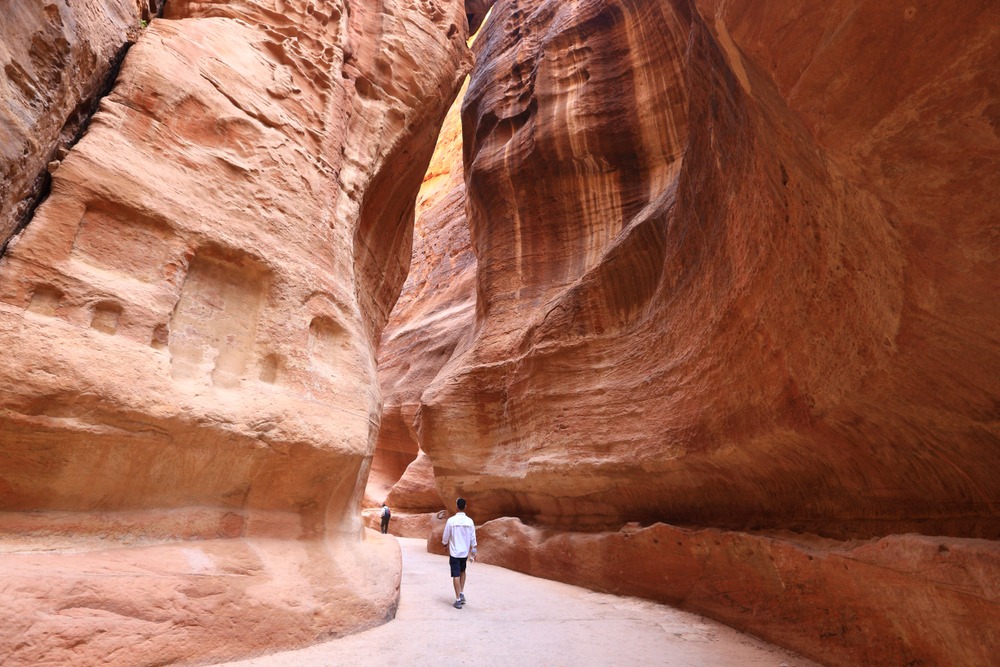
Al Khazneh marks the dramatic entrance to Petra. The facade emerges suddenly after 1.5 km of walking through the Siq, a rocky canyon whose walls gradually narrow until a vertical fissure reveals the Corinthian columns of the monument.
The tomb illustrates the fusion of Nabataean and Alexandrian Greek art: Hellenistic architecture, iconography blending Egyptian, Greco-Roman and Nabataean deities, stucco work against a pink backdrop. It is also the site made globally famous by Indiana Jones and the Last Crusade (1989), which featured it as the setting for its final scene.
History of the Treasury
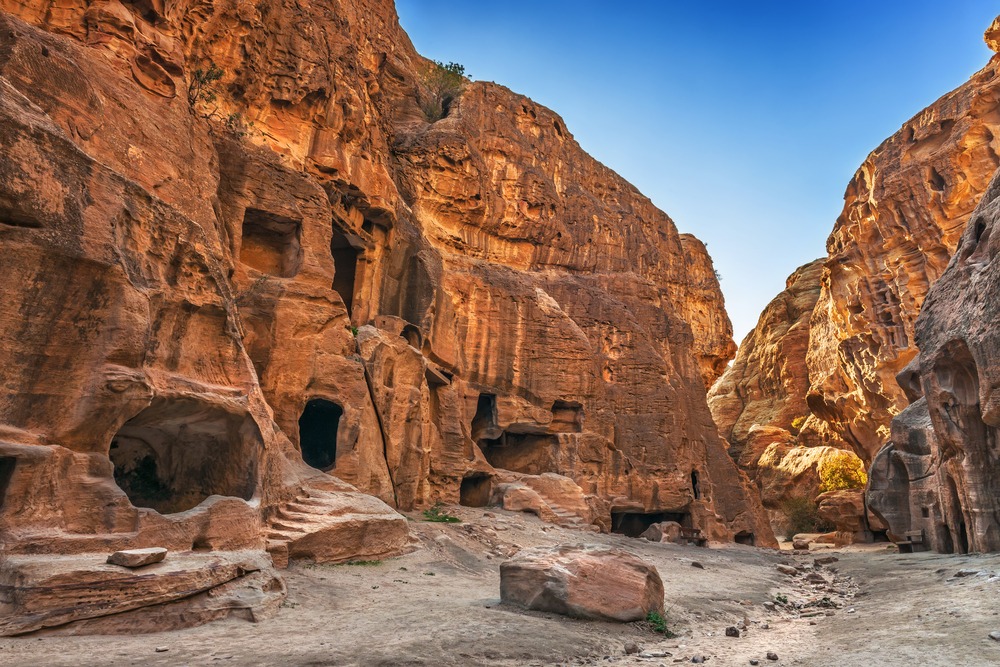
Petra was first home to an Edomite colony before falling to the Nabataeans around 100 BCE. The city then experienced extraordinary urban renewal, and its notables carved elaborate-façaded tombs into the rock. Al Khazneh is the most refined example.
Theories about its function vary. The figures of Castor and Pollux at the entrance—twin brothers venerated as demigods and depicted in equestrian statues—suggest a royal mausoleum. The monument is generally attributed to the Nabataean king Aretas IV or his wife. A cultic use following the fall of the Nabataean kingdom is also accepted.
Weakened by earthquakes and the shift of trade routes, Petra gradually fell into obscurity during the Middle Ages. The site was rediscovered in 1812 by Swiss explorer Jean Louis Burckhardt. Having heard of ancient ruins hidden in Wadi Mousa, near Aaron's tomb, he traveled there disguised as a pilgrim and hired a local guide to show him the way.
Burckhardt later wrote in his memoirs: "An excavated mausoleum came into our view, whose location and beauty were skillfully designed to make an extraordinary impression on the traveler, after passing for half an hour through a dark and nearly underground passage. The natives call the monument Kaszr Faraoun or castle of the Pharaoh and claim it was the palace of a prince. I would rather say it was the sepulcher of a prince."
The name Al Khazneh—"Treasury" in Arabic—comes from a legend widespread among the Bedouins: they believed that plunder from the Egyptian Pharaoh was hidden in the urn carved at the top of the facade.
What to observe on the facade
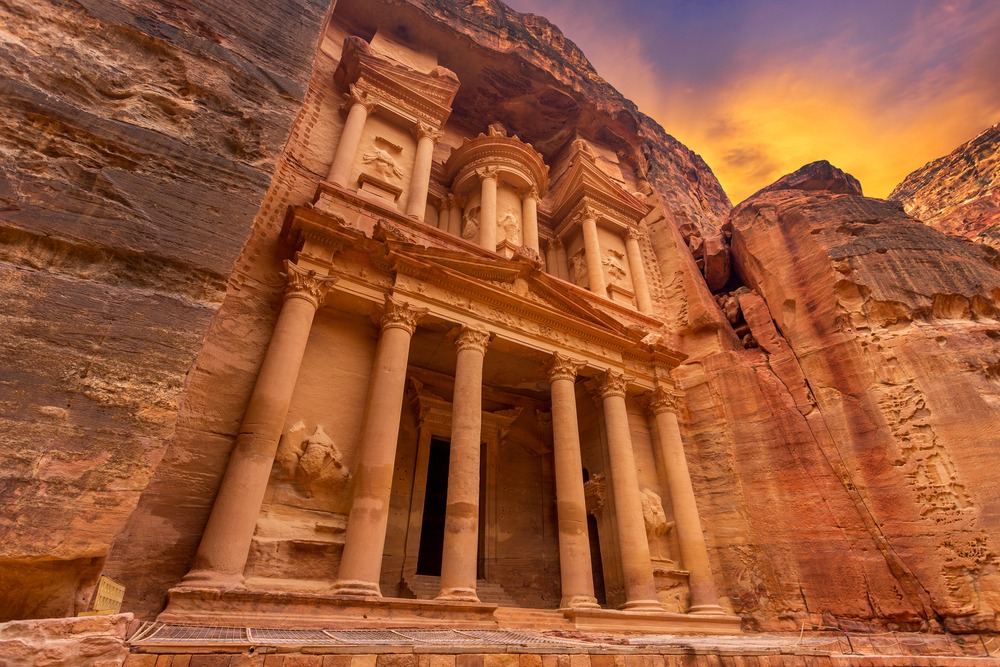
The facade is carved directly into the sandstone wall, standing nearly 40 meters high and approximately 25 meters wide. It is organized on two levels:
- Lower level: six Corinthian columns supporting capitals and decorative friezes, topped by a triangular pediment above the entrance door.
- Upper level: a circular structure (the tholos) flanked by two pavilions, crowned by a large funerary urn.
The iconographic program pays tribute to Egyptian, Nabataean and Greco-Roman deities:
- at the center of the upper level, a statue of Isis;
- on either side of the entrance, the equestrian statues of Castor and Pollux;
- dancing Amazons, axes raised in a sign of battle;
- in the upper section, figures of eagles bearing souls to the afterlife, sometimes identified with poorly understood Nabataean deities.
Looking closely at the upper urn, you will notice bullet holes. They testify to shots fired by Bedouins hoping to dislodge the "pharaoh's treasure." Since the mausoleum is carved from solid sandstone, their attempts left only these marks.
Visitors are not permitted to enter the Treasury enclosure. The interior consists of a single empty chamber: the Nabataeans concentrated their work on the facade, designed to impress distinguished visitors.
Practical information
Access to Al Khazneh is included in the entrance ticket to the Petra archaeological site. Holders of the Jordan Pass enjoy free entry.
The site is open daily, with longer hours in summer than in winter. Allow approximately 30 to 45 minutes of walking from the park entrance to reach the facade, passing through the Siq. Bring sturdy shoes, water and a hat: there is no shade along the route.
When to visit
The most pleasant period runs from March to May and September to November, when temperatures remain manageable. Summer is very hot and winter can be cool, with occasional sudden rains in the canyons.
For light and photography, prefer mid-morning: the sun penetrates the Siq and directly illuminates the rose-orange facade of the Treasury, typically between 9 AM and 11 AM depending on the season. Arriving early also helps you avoid crowds of visitors and camel caravans that fill the plaza at midday.
How to get there
Petra is approximately 3 hours' drive from Amman via the Desert Highway, the quickest route, or 4 to 5 hours via the King's Highway, which is far more scenic. From Amman, you can reach Wadi Mousa, the village that serves the site, by rental car, long-distance JETT bus, public minibus or private taxi.
Once there, access to Al Khazneh is on foot from the visitor center, passing through the Siq. Horses, donkeys and carriages are available along the route.
What to see nearby
Al Khazneh is only the first stop on a visit to Petra that can take one to several days. In the immediate vicinity, you'll find the Royal Tombs, the Nabataean theater carved into the rock, the Colonnade Street and, after climbing approximately 800 steps, the Monastery (Ad-Deir).
More broadly in Jordan, several sites complement a historical itinerary:
- Al-Karak Castle, a Crusader fortress on the King's Highway.
- Ajlun Fortress, a 12th-century Ayyubid citadel.
- Machaerus Fortress, overlooking the Dead Sea.
- Saint George's Church in Madaba and its famous mosaic map.
Frequently asked questions
Frequently asked questions
No. Access to the enclosure is prohibited for conservation reasons. The interior, moreover, contains only an empty chamber: the Nabataeans primarily worked on the facade.
The sun illuminates the facade directly only in mid-morning, typically between 9 AM and 11 AM depending on the season. Before that, the monument remains in the canyon's shadow; afterward, the light becomes more raking.
Yes. The facade serves as the setting for the final scene of Indiana Jones and the Last Crusade, released in 1989. Only the exterior shots were filmed on location; interior scenes were reconstructed in a studio.
Allow at least half a day to reach Al Khazneh, observe it and return. To explore all of Petra—the theater, Royal Tombs, Monastery—plan for one to two full days.
"Al Khazneh" means "the Treasury" in Arabic. The name comes from a Bedouin legend claiming that Pharaonic plunder was hidden in the urn carved at the top of the facade. The Bedouins also called it Kaszr Faraoun, "the castle of the Pharaoh."
Planning your trip
Al Khazneh is the highlight of a visit to Petra and an almost mandatory stop on any Jordan itinerary. To incorporate the site into a complete circuit—Amman, Dead Sea, Wadi Rum, Aqaba—consult our journeys in Jordan.
Interested in this visit?
We can include it in your personalised itinerary.