Pharaoh's Island
Pharaoh's Island
An Egyptian islet off Aqaba, Pharaoh's Island is home to a 12th-century Crusader fortress and a reef renowned for diving, accessible by excursion.
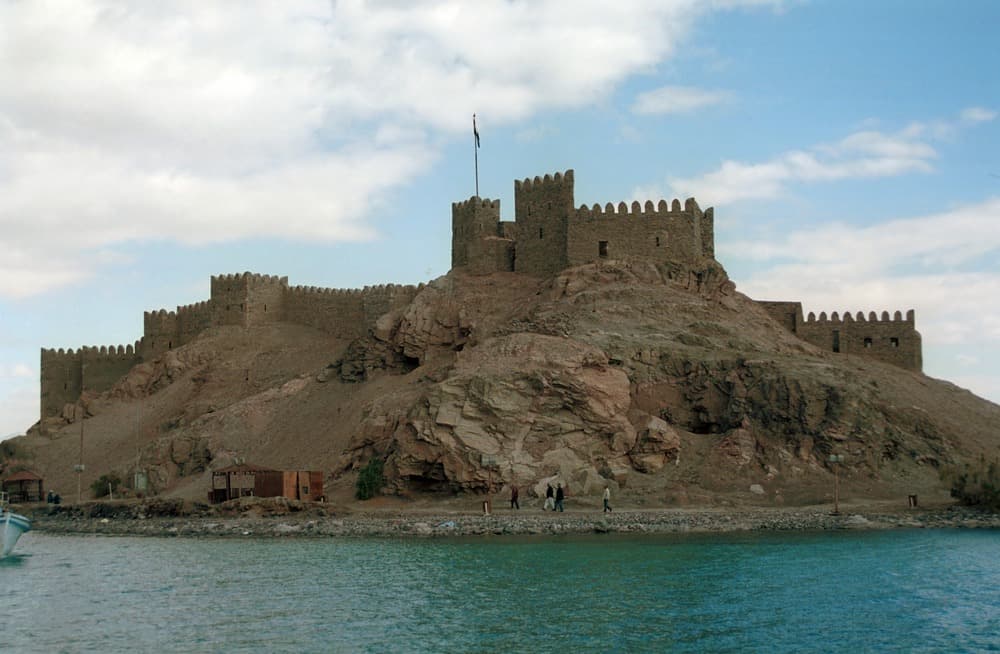
The Pharaoh's Island is an Egyptian islet located in the northern Gulf of Aqaba, off the Sinai Peninsula. A notable feature: from Jordan, travelers can access it as part of a boat excursion without obtaining permission to enter mainland Egypt. The islet, topped by a medieval fortress, combines historical interest with a recognized diving site.
Why visit Pharaoh's Island?
Also known as Graye Island, Coral Island or Ayla, this granite island measures 300 meters long by 100 meters wide. It comprises two large rocky outcrops rising about twenty meters above sea level, located 250 meters off the eastern Sinai shore, approximately 17 km from Aqaba.
The site's appeal rests on three pillars: a fortress built by Crusaders in the 12th century, panoramic views of four countries (Egypt, Israel, Jordan, Saudi Arabia) from the ramparts, and an underwater environment conducive to diving and snorkeling. The site has been on Egypt's UNESCO World Heritage tentative list since July 28, 2003.
History of the island
Archaeological excavations attest to occupation as early as the Ramesside period. The fortress was built by Crusaders around 1160 to defend the nearby oasis of Ayla, a strategic caravan passage between the Red Sea and the Levant.
In 1170, the citadel fell into the hands of Saladin, who fortified it. Renaud de Châtillon attempted to recapture it in 1182, but his limited naval forces made the operation futile. Another siege, in 1184, also failed. In 1217, pilgrim Thietmar stopped there and reported a Muslim population coexisting with Christian captives.
In the 14th century, the citadel hosted the Mamluk governor of Aqaba, who resided there until 1320. The island was subsequently gradually abandoned. A UNESCO World Heritage inscription initiative launched in 1994 resulted in its listing on Egypt's tentative list in 2003. The fortress visible today underwent a reconstruction deemed excessive, departing significantly from its original medieval appearance.
What to see and do
The citadel
The visit begins with exploration of the fortress, organized around small chambers, circular towers for archers and towers dedicated to messenger pigeons. From its highest points, views extend simultaneously to the shores of all four countries bordering the gulf.
The island also preserves remains of Hellenistic and Byzantine foundations, evidence of continuous occupation before the Crusader period.
Diving and snorkeling
Several dive sites surround the islet. The best-known is the Picasso Reef, organized around an underwater mountain bordered by coral tables, where the Picasso triggerfish, which gives the reef its name, can be observed. Near the port, stone pillars are visible beneath the surface, remnants of a submerged structure.
For non-divers, a small bay protected by a breakwater offers calm conditions for swimming and snorkeling from the shore.
Practical information
- Duration of visit: allow a minimum of half a day as part of an organized excursion.
- Rates: vary by operator; verify what is included (transfers, lunch, diving equipment).
- Equipment: bring sunscreen, hat, water and shoes suitable for walking on rocky terrain.
- Documents: the excursion formula from Aqaba does not require a standard Egyptian visa, but specific arrangements govern access. Check with your operator.
When to visit
The region's climate is arid and hot, with an annual average around 30°C and peaks reaching 39°C in summer. The most pleasant periods for combining cultural visits and outdoor activities extend from February to May and during October and November. For swimming, sea temperatures remain favorable from June to October.
How to get there
Access is exclusively by organized boat excursion departing from Aqaba. The crossing takes approximately fifty minutes depending on sea conditions. Packages typically include transport and on-island guidance; additional services (lunch, guided diving, snorkeling) vary by operator.
Nearby attractions
Pharaoh's Island fits naturally into a loop starting from Aqaba, an ideal base on the Red Sea. To extend your exploration of Jordan, several major sites are within a few hours' drive:
- Al Khazneh, the iconic façade of Petra;
- the Sîq, the defile providing access to the Nabataean site;
- Al-Karak castle, a perched Crusader stronghold;
- the Machaerus fortress, mentioned in ancient sources.
Frequently asked questions
Frequently asked questions
Preparing your journey
Pharaoh's Island fits naturally into an itinerary combining Aqaba, Wadi Rum and Petra. To build a cohesive trip, consult our bespoke journeys in Jordan.
Interested in this visit?
We can include it in your personalised itinerary.