Dead Sea and Jordan Valley
The lowest point on Earth's land surface, the Jordanian shore combines salt-water floating, the aquatic canyons of Mujib and the baptismal site of Al-Maghtas, an hour from Amman.
The Dead Sea occupies the lowest point on Earth's land surface, at 430 metres below ocean level, and the seabed continues to sink by approximately one metre each year as the sea recedes. Its Jordanian shore, traced by Route 65, stretches for some fifty kilometres between Suweimah to the north and the Wadi Mujib delta to the south. The air here is heavy, laden with bromine, and the raking evening light transforms the salt banks into white crusts that crack beneath your feet. To the north, the Jordan Valley rises towards the Sea of Galilee; to the east, the cliffs of the Moab Plateau plunge sheer from Madaba, a thousand metres higher.
The Jordan Valley has long been the country's agricultural heartland. On the irrigated terraces of Deir Alla, Karameh and Shouneh, we pass rows of tomato greenhouses, banana plantations and Medjool date palms whose October harvest feeds the export trade. The families settled here are partly descendants of Palestinian refugees from 1948 and 1967, and the social fabric differs noticeably from that of the high plateaux. Friday mornings, the Shouneh Janoubieh market mingles produce stalls with saj bread cooked on convex griddles.
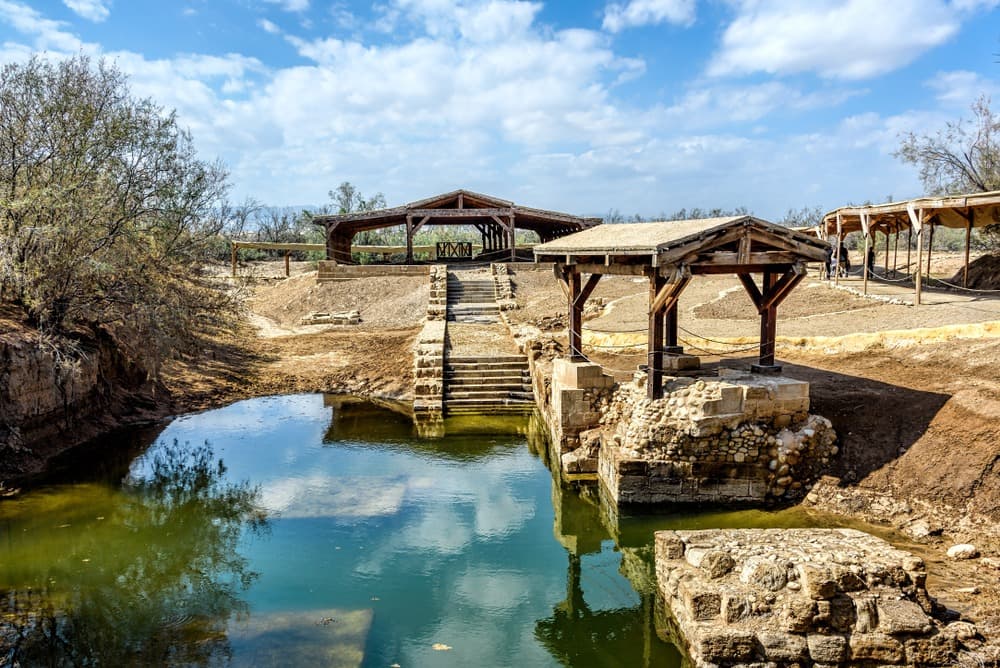
The site of Bethany Beyond the Jordan, Al-Maghtas, lies ten kilometres north of the Dead Sea. Recognised by UNESCO in 2015, it contains the remains of five Byzantine churches, baptismal pools and the ancient bed of the Jordan identified as the site of Christ's baptism according to Christian tradition. The present river, reduced to a muddy trickle just a few metres wide at this point, marks the border with the West Bank: the opposite shore, the Israeli site of Qasr al-Yahud, is visible within earshot.
Further south, the Wadi Mujib biosphere reserve descends from the heights of Dhiban to the shoreline. The main gorge, the Siq Trail, can be hiked through the water between April and October, with sections where you swim for a few metres between red sandstone walls narrowed to just two metres. Wadi Zarqa Ma'in, accessible from Ma'in Hot Springs hotel, combines a 40°C hot waterfall plummeting down the cliff face and a more demanding canyon for equipped hikers. Both wadis are managed by the Royal Society for the Conservation of Nature, which strictly regulates access.
Swimming in the Dead Sea is concentrated on a few beaches: Amman Beach, public and budget-friendly, the private beaches of the major hotels in the Sweimeh resort complex, and O Beach a little further south. The water, ten times saltier than the Mediterranean at 34% salinity, carries your body effortlessly but stings the mucous membranes and any cuts. The black mud applied to the skin comes from the clay deposits of the shoreline, rich in magnesium and potassium; it feeds a small local cosmetics industry around Sweimeh.
Two days on site suffice to combine a morning at Bethany, a descent of Wadi Mujib and a half-day of floating. The region is poorly suited to long stays: summer heat, beach tourism concentrated in resorts and the sparse density of traditional villages make it more of a stopover than a main destination.
Must-see
Floating on the Dead Sea. Lying on your back at Amman Beach or from a Sweimeh beach, your body rises to the surface of its own accord. The water stings slightly and leaves a salty film that must be rinsed quickly.
Al-Maghtas baptismal site. Byzantine remains, submerged pools and descent to the Jordan riverbank where tradition locates Christ's baptism. Guided visit by shuttle from the visitor centre, approximately two hours.
Siq Trail in Wadi Mujib. Ascent of a red sandstone canyon through flowing water, with fixed ropes and swimming passages, between April and October. Allow three hours return from the Route 65 bridge.
Ma'in hot springs. Hot waterfall cascading down a cliff face at the bottom of a desert wadi, at 264 metres below sea level. Access via Ma'in Hot Springs hotel or hiking from the plateau.
Friday market at Shouneh. Stalls of bananas, citrus fruits and fresh herbs grown in the Jordan Valley, frequented by agricultural families from the plain. A good stopping point when descending from Jerash towards the Dead Sea.
When to go
The region is comfortably visited from mid-October to mid-April, with daytime temperatures between 22 and 28°C at the Dead Sea shore and mild nights around 15°C. This is also the most pleasant window for Al-Maghtas, where shade is scarce on site. Rainfall is rare, concentrated from December to February, and generally does not exceed 100 mm cumulatively over the season.
From June to September, temperatures regularly climb to 40-42°C during the day at Dead Sea level, and the heat brings strong evaporation that makes the air muggy. These months nonetheless remain the only season when Wadis Mujib and Zarqa Ma'in are accessible for aquatic canyoning, as water flow is too high and water too cold in winter. The authorities close the Siq Trail from November to the end of March. To combine wadi swimming and thermal comfort, aim for May-June or September-early October.
Practical advice
Two full days constitute the right duration for this region: one day for the Dead Sea and baptismal site, one day for the wadis and hot springs. Access is by road from Amman, 55 kilometres away and approximately one hour's descent via Route 40, which connects the capital to Sweimeh. There is no regional airport; international arrivals are at Queen Alia (QAIA).
The Dead Sea logically integrates between Amman and the North at the start of your journey and the descent to Petra and the King's Highway via Karak and Madaba. It can also serve as a decompression stopover at the end of a circuit, after Wadi Rum and Aqaba, before your return flight. The comfort level is high on the northern shore, with a concentration of international resorts at Sweimeh, or more modest around Madaba for those preferring to lodge on the plateau. The region suits travellers seeking a break after desert trekking, families with children who enjoy pools and supervised beaches, and hikers interested in aquatic canyons during the warm season.