Iraq Al Amir
Iraq Al Amir
Just 15 km from Amman, Iraq al Amir conceals Jordan's most beautiful Hellenistic castle, prehistoric caves and the legend of Tobias. An escape off the beaten path.
Nestled in the heart of the Jordan Valley, the village of Iraq al Amir – Caves of the Prince in English – is renowned for its Hellenistic castle and surrounding caves.
Iraq Al Amir, a journey through time near Amman
Visiting Iraq al Amir is a privilege for antiquity enthusiasts passing through Jordanie. "Caves of the Prince" – this is what the village's name means. A name it owes to the surrounding rocky caves, which the ancestors of the Abaddi tribe colonized in prehistoric times. As you hike through, you'll encounter a succession of dwellings carved directly into the rock. You'll stroll among olive and fruit trees. Yet visitors' true highlight at Iraq al-Amir is the Qasr Al-Abd. The Qasr al-Abd, or Castle of the Slave, which stands at the village's heart, is considered the finest masterpiece of Hellenistic art in Jordanie. Iraq al Amir was affectionately called Tyros by the Greeks.
History of the site
The earliest traces of human activity on the site date back between ten thousand and eight thousand years B.C. In this remote age, humans had no knowledge of construction. Dwellings were carved directly into the cliff face.
Invaded by the troops of Alexander the Great in 332 B.C., the village of Iraq al Amir flourished during the Hellenistic civilization, later became a Roman colony before falling into Byzantine hands in the fourth century of the Christian era.
The historical facts of the village are well documented. We know, for example, from the memoirs of Flavius Josephus, that the Qasr Al-Abd castle was surrounded by water on all sides. According to the research of Mohammad Waheeb, an archaeologist and professor at the Hashemite University, Jesus and his disciples rested in the Al-Bassah cave during their travels through the Jordan. A small chapel marks the Savior's passage at this spot. Finally, fragments of pottery and ceramics attest to Mamluk and Umayyad presence.
Today
With its magnificent open-air castle, Iraq al Amir ranks among the historic sites worth visiting on an excursion from Amman. The village sits amid verdant pastures, with troglodytic dwellings perched in the mountains. Tourism remains light; all the more reason to visit Iraq Al Amir if you wish to escape the bustling, congested streets of Amman.
Must-see attractions
Three monuments are worth seeing on site, either as a self-guided visit or with a local guide:
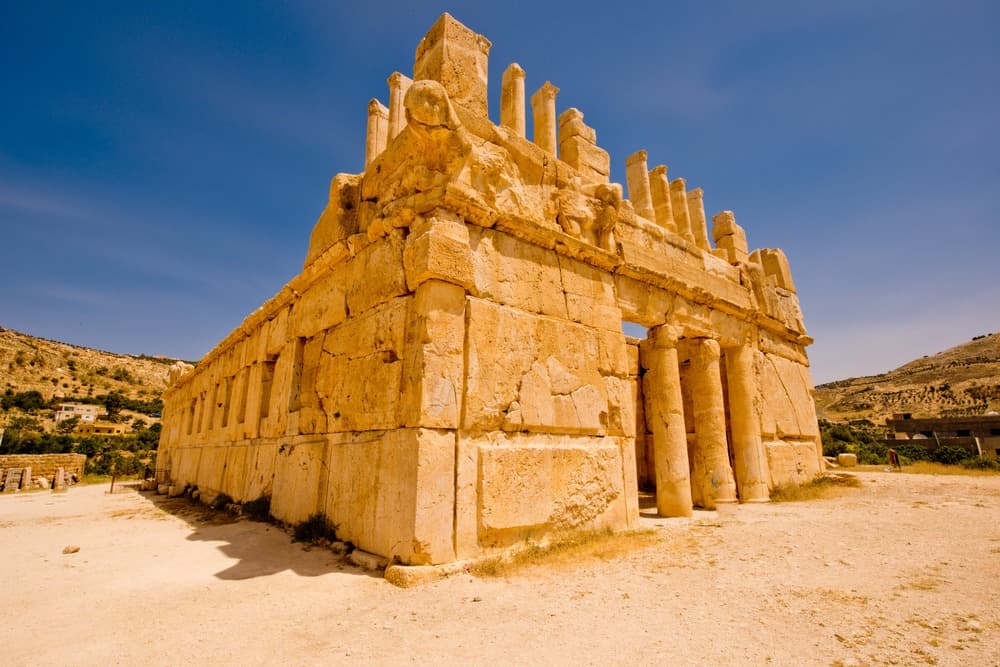
Qasr al-Abd, the Castle of the Slave
It would be impossible to visit Iraq Al Amir without stopping at its main monument, the Qasr al-Abd, where the refinement of Persian art blends with the expertise of Alexandrian Greeks. The foundation of the Slave's mansion dates back to the second century B.C. According to local legend, the castle resulted from a deception. The commoner Tobias was in love with a noblewoman. He asked her father for her hand in marriage. His request was granted, but Tobias had to build a palatial residence as a wedding gift for his future bride. Tobias kept his word, but the powerful lord did not. Once the castle was completed, he ordered Tobias killed, refusing to marry his daughter to a man of low birth.
Perched on a hilltop, the palace majestically overlooks the cluster of troglodytic dwellings hidden in the mountains. Rectangular in shape, it measured 38 meters long and 19 meters wide, with a height of around ten meters. The ornamentation of the friezes, the masonry in hard limestone and crystalline stones, the sculptures of tigers and lions on the walls are magnificent examples of Hellenistic art.
The Women's Cooperative
Within a short walk of the castle, the Women's Cooperative of Iraq Al Amir will be delighted to welcome you. The village women are masters in the art of pottery, textiles and decorative papers. Do not hesitate to purchase the fruits of their labor. Craftsmanship is a secondary source of income for these women to support their families, while also being a cultural heritage to share with visitors.
The Church and Al-Bassah Cave
Among the fifteen caves dotting the village's cliffs, Al-Bassah stands out remarkably. Jesus and his twelve disciples set foot here when they traveled through Jordanie. The cave entrance features a barrel vault. Above the doorway, visitors can observe crucifixes engraved within a pediment. The cave is not merely a historical monument. To the village community, it holds profound sentimental and emotional value.
The church near the cave is a remarkable Byzantine ruin. You must enter to discover the apse with its rows of benches where parishioners sat, and the floor adorned with fine mosaics.
Best time to visit
March to May and October to November offer pleasant climate conditions. Summers can be exceptionally hot.
Some 15 kilometers of road separate Iraq Al Amir from the capital. Between buses, taxis and private cars, everyone will find suitable transportation. If you take public transport, avoid Fridays if possible, as buses depart rarely after 8 a.m.
Nearby tourist sites
Once you've finished touring the archaeological ruins of Iraq Al Amir, continue your journey to Mount Nebo, the burial place of Moses, then to Ajloun Castle and the city of As-Salt, recently inscribed on the UNESCO World Heritage list.
Want to discover this destination?
Our local advisors design your tailor-made trip.