Royal Tombs
Royal Tombs
At the foot of Mount al-Khabta in Petra, four Nabatean tombs carved into the cliff bear witness to the end of the kingdom and its dialogue with Rome.
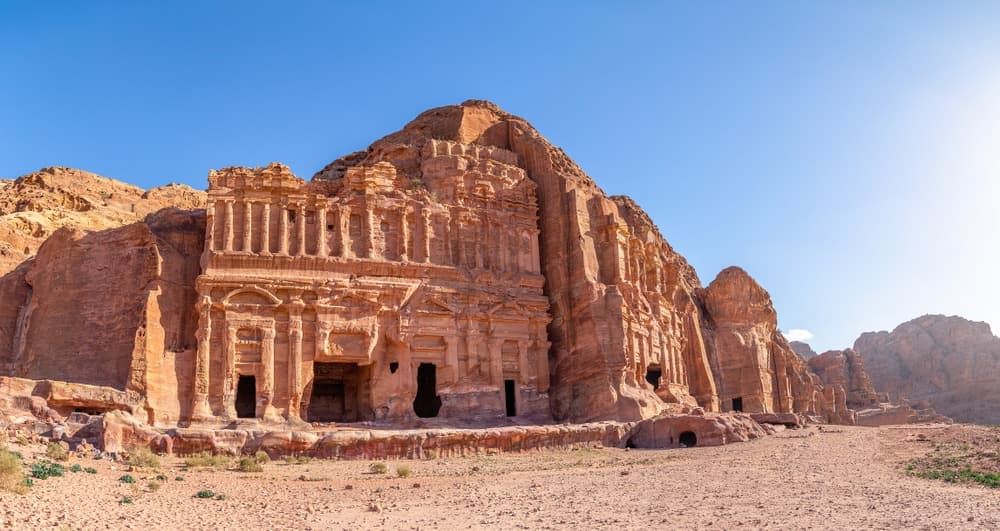
On the eastern flank of the Petra valley, at the foot of Mount al-Khabta, four monumental façades line the rocky cliff face: the Royal Tombs. Carved into sandstone by the Nabateans between the 1st and 2nd centuries CE, they housed the burials of the kingdom's sovereigns and high dignitaries. The Palace Tomb, the Corinthian Tomb, the Silk Tomb and the Urn Tomb form a unique funerary complex, a testament to the architectural wealth of a caravan city that engaged in dialogue with Rome and the Hellenistic East.
Why visit the Royal Tombs of Petra
Often overshadowed by the Khazneh and the Deir, the Royal Tombs are nonetheless one of the most instructive ensembles on the site. Their appeal lies in several factors:
- A rare architectural concentration: four monumental tombs aligned over several hundred meters, each illustrating a different style (Corinthian, classical, Romanizing).
- An exceptional viewpoint over the center of Petra: from the esplanade before the façades, you command a view of the theatre, the cardo and the Wadi Musa valley.
- Less crowding than at the major sites, allowing for a more leisurely reading of the sculpted details.
- The Palace Tomb, the largest tomb carved directly from Petra's rock, whose dimensions (49 m high, 46 m wide) still impress despite erosion.
History of the Royal Tombs
The Royal Tombs belong to the late phase of the Nabatean kingdom, at a time when Petra was massively absorbing the codes of Roman architecture. The Palace Tomb, the most monumental of the group, is believed to have been commissioned toward the end of the 1st century CE by King Rabbel II (70-106 CE), the last Nabatean ruler before annexation by Trajan in 106. Its three-level façade directly imitates the Domus Aurea ("House of Gold") of Nero in Rome, a sign of imperial influence on Petra's court.
The three other tombs—Corinthian, Silk and Urn—date from the same period or slightly precede it. Together, they testify to Nabatean syncretism, blending Arab, Hellenistic and Roman traditions.
Winter 1988 marked the recent history of the Palace Tomb: the rupture of a water channel leading to a reservoir built on the roof caused the collapse of part of the uppermost level. The Jordanian authorities then appealed to UNESCO, which intervened to consolidate the monument and helped finance part of the stabilization work.
What to see on site
The Palace Tomb
Its façade unfolds over three levels. The lower register features 12 columns and 4 doors, each leading to a funerary chamber carved into the rock. The two central entrances are wider than the lateral ones and are distinguished by triangular pediments, while the other two feature semicircular pediments. Inside, some chambers preserve tombs cut into the floor and lateral niches.
The second level aligns 18 columns with unevenly spaced capitals, separated by niches whose arrangement breaks with expected symmetry. The uppermost level, partly built from masonry stone blocks (rather than carved from the cliff), is today largely destroyed; the remains suggest a superstructure more complex than the lower levels.
The three other tombs
- Urn Tomb: recognizable by its arcaded courtyard and the urn carved atop the pediment. Repurposed as a Byzantine church in the 5th century.
- Silk Tomb: its more modest façade is chiefly noteworthy for the colored veins in the sandstone, which create patterns reminiscent of shimmering silk.
- Corinthian Tomb: heavily eroded façade but retains an upper level reminiscent of the Khazneh, with a central tholos.
Practical information
The Royal Tombs are located within the Petra archaeological park, approximately 250 km south of Amman. Access is from the site's main entrance, by way of the Sîq, then proceeding up the main pathway that passes the Roman theatre. Budget 30 to 45 minutes of walking from the entrance.
The site entrance ticket grants access to all monuments, including the Royal Tombs. The fee varies according to visit duration (1, 2 or 3 days) and your status (day-tripper or traveler staying in Jordan). Check the current rates at the time of your visit, as they are regularly adjusted.
To reach Petra from Amman, several options exist: rental car, long-distance taxi, or bus service with JETT and Alpha Daily Tours companies, which serve the park daily.
Plan for sturdy shoes, water, a hat and a windbreaker: the valley is exposed and stones can be slippery. Allow 1 to 2 hours just for the Royal Tombs if you wish to ascend to the façades and explore the accessible funerary chambers.
When to visit
The best seasons to visit Petra and its Royal Tombs are spring (March to May) and autumn (September to November). Temperatures remain manageable for walking, and the raking light of morning or late afternoon particularly sets off the red sandstone of the façades. In summer, temperatures frequently exceed 35 °C in the valley; winter is milder but may bring sudden showers, sometimes causing flash floods in the wadis.
What to see nearby
The Royal Tombs fit into a broader exploration of Petra and its major sites. In the immediate vicinity, do not miss the Sîq, the natural gorge that forms the scenic entrance to the Nabatean city. More broadly, your Jordanian itinerary could include the Temple of Hercules on Amman's citadel, Ajlun Fortress to the north, or Al-Karak Castle on the Kings' Highway.
Frequently asked questions
Frequently asked questions
There are four main Royal Tombs aligned at the foot of Mount al-Khabta: the Palace Tomb, the Corinthian Tomb, the Silk Tomb and the Urn Tomb.
The name derives from the three-level façade, which imitates the architecture of Roman palaces, particularly Nero's Domus Aurea ("House of Gold").
Yes, the lower funerary chambers of the Palace Tomb and Urn Tomb are accessible. The upper levels, weakened (especially since the 1988 collapse at the Palace Tomb), are not open to the public.
Allow 1 to 2 hours to visit all four Royal Tombs and enjoy the viewpoint over central Petra. A complete tour of the entire site requires a minimum of a full day.
Petra is located approximately 250 km south of Amman. You can reach it by rental car, long-distance taxi or bus service with JETT and Alpha Daily Tours companies.
Preparing your trip
The Royal Tombs are far more than a stop along the Petra route: they tell in themselves the story of the end of the Nabatean kingdom and its dialogue with Rome. To incorporate them into a complete itinerary—Petra, Wadi Rum, the Dead Sea, desert castles—consult our selection of journeys in Jordan and build with our advisors a stay tailored to your pace.
Interested in this visit?
We can include it in your personalised itinerary.