Umm el-Jimal
Umm el-Jimal
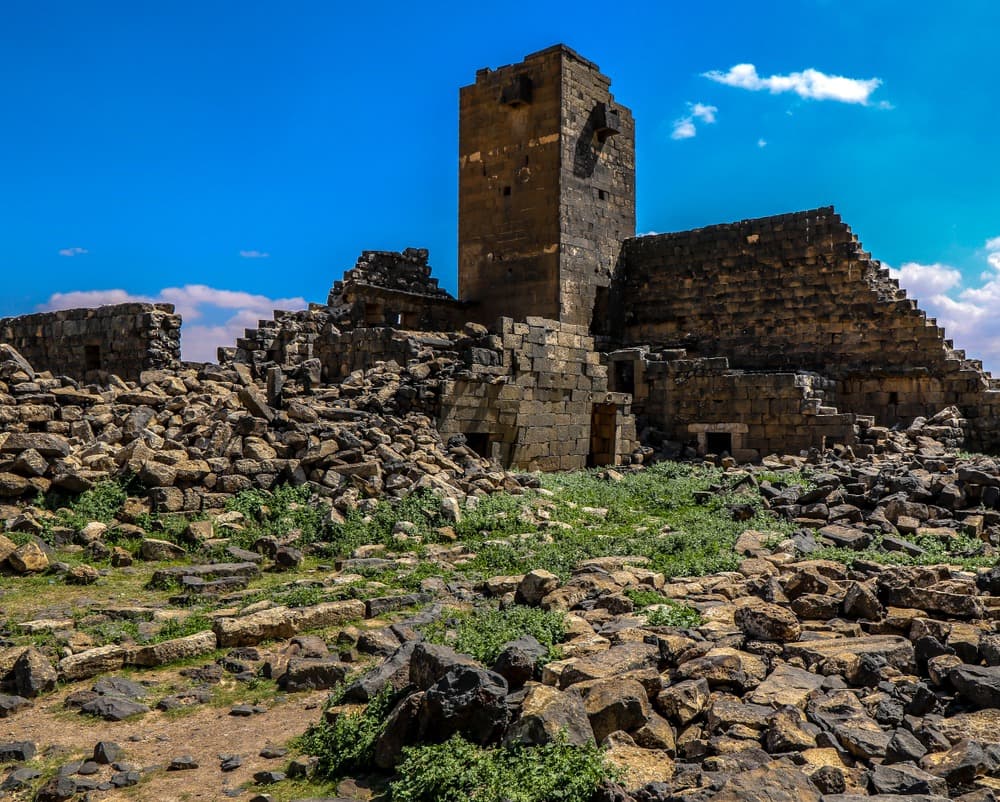
Umm el-Jimal is an ancient city in northern Jordan built entirely of black volcanic basalt. Multi-story houses, Byzantine churches, and cisterns have been preserved from the Nabataean era through the Umayyad period.
Umm el-Jimal is an ancient city in northern Jordan, some fifty kilometers east of Mafraq, near the Syrian border. Built from black volcanic basalt, it presents a remarkable assemblage of houses, churches, and water reservoirs. Inhabited continuously from the Nabataean era through the Umayyad period, it offers a rare glimpse into rural urbanism in the ancient Near East.
Practical Information at a Glance
- Access: car recommended from Mafraq or Amman; no regular public transport to the site.
- Suggested duration: 2 to 3 hours to explore the full site.
- Dress code: no particular requirements, but closed-toe shoes recommended (uneven basalt terrain).
What to See
The site spans several hectares of black basalt ruins. Multi-story houses still standing, cisterns and irrigation channels that testify to a sophisticated water system, and about fifteen Byzantine churches are visible. Nabataean, Greek, and Arabic inscriptions carved into the stone constitute a precious historical record.
History and Context
Umm el-Jimal emerged as a Nabataean settlement around the 1st century. Integrated into the Roman province of Arabia after 106 CE, it developed as a caravan relay station and agricultural center. It reached its peak during the Byzantine era (4th-6th centuries), then continued to be inhabited under the Umayyads before gradually being abandoned. Its construction entirely from local basalt explains the exceptional preservation of its structures.
Highlights of Your Visit
Multi-story Basalt Houses
Several dwellings preserve their lintels, staircases, and sometimes their roofs of basalt slabs. Ancient domestic architecture is readable here as nowhere else in Jordan.
The Water System
Umm el-Jimal survived in a semi-arid environment thanks to a network of cisterns, canals, and rainwater collection basins. This system, largely still visible, illustrates the ingenuity of its inhabitants in the face of drought.
The Byzantine Churches
About fifteen religious buildings have been identified on the site. Some preserve their apses and walls standing several meters high, offering a precise understanding of the organization of the local Christian community.
Multilingual Inscriptions
The walls and lintels bear inscriptions in Nabataean, Greek, Latin, and ancient Arabic. These make Umm el-Jimal a reference site for specialists in regional epigraphy.
Photography Tips
The golden light of late afternoon creates a strong contrast with the black basalt and reveals the texture of the stones. Early morning, the site is often empty, making it easier to frame shots without visitors. Avoid midday in summer: the heat and harsh light flatten the volumes.
Location and Access
Umm el-Jimal is located in the Mafraq governorate, in the basalt desert of northeastern Jordan (Harrat al-Sham). The road from Mafraq is paved. From Amman, allow approximately 1.5 to 2 hours of driving. The site is little frequented: no heavy tourist infrastructure on site. Accessibility for people with reduced mobility is limited due to the uneven volcanic terrain.
In the Vicinity
- Jerash — one of the best-preserved Greco-Roman cities in the Middle East, approximately 1.5 hours to the west.
- Azraq Castle — basalt fortress to the east, a stopping point on the desert castles route.
- Qasr al-Hallabat — Umayyad complex combining baths and mosaics, in the same desert region.
Frequently asked questions
Spring (March-May) and autumn (September-November) offer pleasant temperatures. Summer is very hot in this basalt desert; winter can be cold and windy.
A local guide considerably enriches the visit: the ruins are poorly marked and interpreting the inscriptions and structures requires expert explanation. Check with your local agency before departure.
Yes, a day trip from Amman allows you to combine Umm el-Jimal with Qasr al-Hallabat or Azraq Castle, by organizing a circuit through the northeastern desert.
Photography is generally permitted at Jordan's archaeological sites open to the public. No particular restrictions are noted at Umm el-Jimal.
There is no regular bus service to the site. A rental car or private driver remains the most practical option.
Photos
Want to discover this destination?
Our local advisors design your tailor-made trip.