Umm Qais (Gadara)
Umm Qais (Gadara)
Perched on a rocky spur in northern Jordan, Umm Qais conceals the ruins of Gadara, a Roman city built in black basalt, with exceptional views over the Sea of Galilee and the Golan plateau.
Umm Qais occupies a rocky spur in northwestern Jordan, where the Jordanian, Syrian and Israeli borders converge. The ancient Greco-Roman city of Gadara spreads across this basalt plateau with its black ruins, columns and mausoleums. Below, the Sea of Galilee and the Golan Heights form a panorama rarely matched in Jordan. The site remains little visited despite its archaeological richness.
Quick practical information
- Admission: paid (included in the Jordan Pass)
- Recommended duration: 2 to 3 hours for the site and museum
- Access: car recommended from Irbid (approximately 30 km); minibuses from Irbid possible but rare
- Dress code: closed-toe shoes advised (uneven basalt terrain)
- Best time: spring (March-May) and autumn (September-November) for light and vegetation
What to see
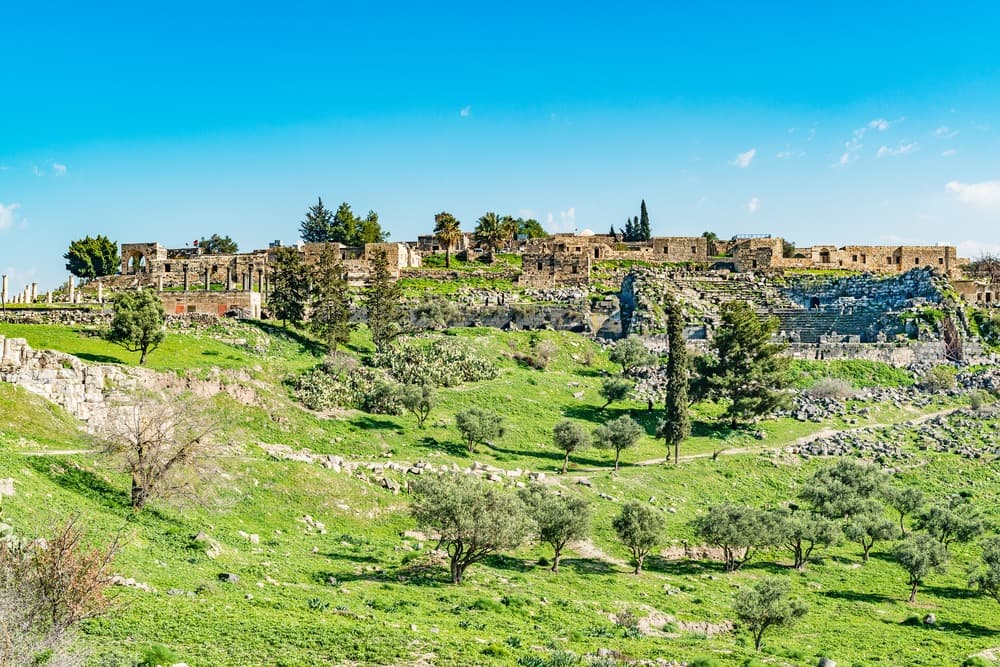
The site is divided between ancient ruins and a partially restored Ottoman village. The columned street in black basalt runs through the heart of Gadara. The Western Theatre, well preserved, offers a direct view over the Sea of Galilee. Two other theatres, thermal baths, a nymphaeum and several mausoleums complete the ensemble. The Archaeological Museum, housed in a former Ottoman residence, displays mosaics, statues and objects from the Decapolis period.
History and context
Gadara was one of the ten cities of the Decapolis, a league of Hellenistic cities under Roman influence. Founded during the Hellenistic period, it flourished in the 1st and 2nd centuries AD under Roman rule. Birthplace of the poet Meleager and the philosopher Menippus, it shone intellectually throughout the region. The Byzantines built churches there; the Umayyads occupied it briefly before medieval earthquakes gradually abandoned it.
Highlights of the visit
The Western Theatre and its panorama
From the black basalt tiers, your gaze sweeps simultaneously over the ruins of Gadara, the Sea of Galilee and, on clear days, the Golan Heights. This unique framing—ancient stage and modern geopolitics—is the visual signature of the site.
The columned street in basalt
Unlike the white limestone cities of the Decapolis (Jerash, Petra), Gadara is built in dark volcanic basalt. The main street, flanked by black columns, gives the site a singular atmosphere and is photographically very different from other Roman sites in Jordan.
The museum in the Ottoman house
The former Ottoman governor's residence now houses the site's collections. Hellenistic mosaics and sculptures are presented in a remarkable architectural setting, with an interior courtyard and vaulted galleries.
The mausoleums and rock-cut tombs
On the periphery of the site, several tombs carved into basalt date from the Roman period. Less visited than the theatre, they testify to the importance of Gadara's necropolis.
Photography tips
Morning light (before 10 a.m.) is ideal: it strikes the basalt columns at an angle and avoids the haze that often veils the lake midday. For the panorama over the Sea of Galilee, position yourself in the upper tiers of the Western Theatre. The contrast between black stone and blue sky is strongest in winter and spring. No known photographic restrictions on the site.
Location and access
Umm Qais lies approximately 30 km northwest of Irbid, Jordan's second-largest city. From Amman, allow about 1 hour 30 minutes by car via the northern highway. Public transport exists from Irbid but remains irregular; car rental or a taxi from Irbid is more reliable. The site is at elevation; access to the ruins involves walking on uneven terrain, which limits accessibility for visitors with mobility challenges.
Nearby attractions
- Jerash (Gerasa) — The best-preserved Roman city in the Near East, approximately 1 hour to the southeast.
- Irbid — Lively university city, logistical starting point for northern Jordan.
- Ajloun Castle — 12th-century Ayyubid fortress perched on a wooded hilltop, approximately 1 hour to the south.
- Pella (Tabaqat Fahl) — Another city of the Decapolis, less restored, in the Jordan Valley.
Frequently asked questions
Yes, site admission is covered by the Jordan Pass, making it a stop at no additional cost if you're already visiting Petra or Jerash with this pass.
Spring (March to May) is optimal: the vegetation is green, the light soft and the Sea of Galilee clearly visible. Autumn (September-November) offers similar conditions. Summer is hot and haze over the lake is frequent.
It's possible by car starting early from Amman, but both sites deserve 2 to 3 hours each. Prefer starting with Umm Qais in the morning for light on the panorama, then head to Jerash in the afternoon.
No strict dress code, the site being archaeological rather than religious. Closed-toe and comfortable shoes are strongly advised due to the uneven basalt.
Minibuses run from Irbid's bus station, but frequencies are limited and schedules variable. A taxi from Irbid is the most practical option for independent travellers.
On clear days, the view is remarkable. In summer and midday, heat haze can reduce visibility. Morning in winter or spring offers the best chances for an unobstructed panorama.
Photos
Want to discover this destination?
Our local advisors design your tailor-made trip.