Bethany Beyond the Jordan
Bethany Beyond the Jordan
Located 50 km from Amman, Bethany Beyond the Jordan (Al-Maghtas) is the UNESCO site where John the Baptist is believed to have baptized Christ. Byzantine ruins and the sacred Jordan River await.
The village of Bethany lies on the eastern bank of the Jordan River, north of the Dead Sea. The place where Christ received baptism has become a major pilgrimage destination.
Pilgrimage to Bethany: Walking in the Footsteps of Elijah and John the Baptist
If you're traveling to Jordan, the site of Bethany Beyond the Jordan is an unmissable stop. Declared a UNESCO World Heritage site, Bethany welcomes a considerable number of pilgrims each year. Some come out of curiosity. The most devoted make the journey to deepen their faith. Regardless of your religion, visiting Bethany Beyond the Jordan is a privilege. Plan an excursion to Bethany and return from your Jordan trip with unforgettable memories.
History of the Site
The baptism of Christ in the Jordan is one of the most celebrated passages in the Gospel. It comes as no surprise, then, that this location has been subject to archaeological excavation. The historical account was proven by a mosaic panel discovered among the ruins of a Byzantine church, at the current site of the Orthodox Church of Saint George in Madaba. It is the oldest map of the Holy Land to have survived to our time. Where opinions diverge is on the exact location of Bethany. While Saint John 1:28 states, "These things happened in Bethany across the Jordan, where John was baptizing," Scripture does not specify which side of the river.
Two hypotheses clash: Jordanians maintain that Jesus was immersed on the eastern bank, a claim disputed by Israelis, who assert the western bank of the Jordan, in line with the thesis of Origen, a Christian philosopher of the 3rd century. The Vatican took the path of neutrality: it declared that both sites hold significant importance for Christian faith as the presumed baptismal basin of the Savior.
Scholars agree on the spiritual significance of the site. John the Baptist's choice to baptize on the sacred Jordan River was intentional. The river lies near the hill where Elijah ascended to heaven. Moreover, John the Baptist preached at the same location as Elijah. This confirms Jewish beliefs that held John to be a reincarnation of Elijah.
Bethany comes from the Aramaic word Al-Maghtas, which means "crossing of the prophets." It should not be confused with the other Bethany, the village where Jesus raised Lazarus, the brother of Mary and Martha.
Today
A site of considerable archaeological significance, Al-Maghtas or Bethany continues to attract millions of pilgrims: Russian Christians, Muslims from Iraq and Syria, European and American nationals… The site's renown has crossed the oceans. UNESCO gave it its credentials by declaring it a World Heritage site in 2016. Bethany Beyond the Jordan is thus the fifth site to be listed in Jordan, after Petra, the famous Nabataean capital, the desert castle of Qasr Amra, the Wadi Rum desert, and the Greco-Roman-Byzantine ruins of Um Rasas.
What to See and Visit
When visiting the site of Bethany Beyond the Jordan, Christian believers will relive well-known biblical scenes.
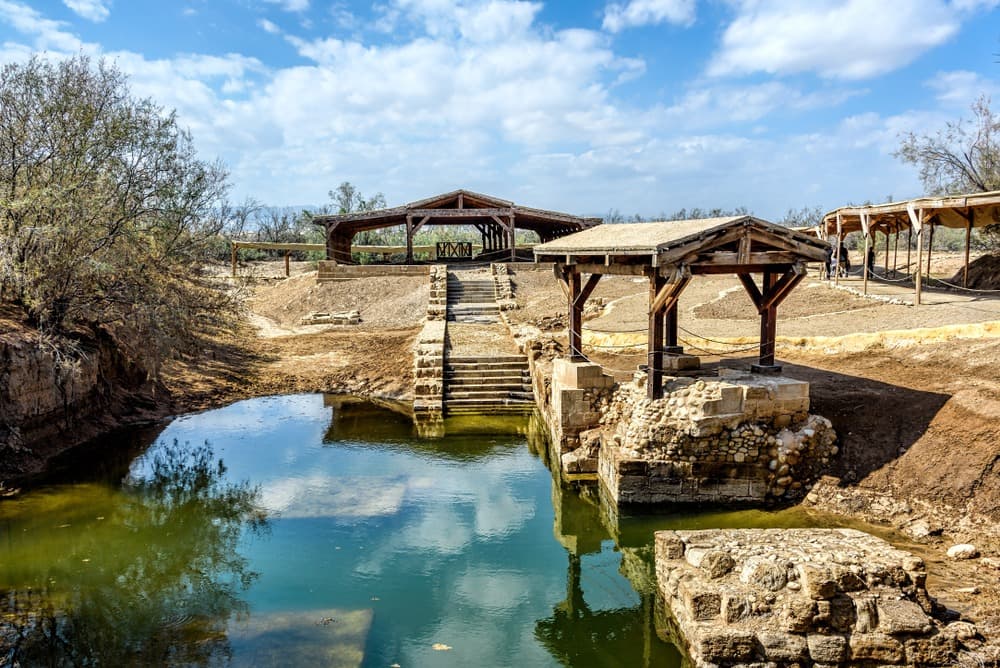
The Baptism Site
It is here, on the banks of the Jordan River marking the border between Israel and Jordan, that John the Baptist is believed to have administered the sacrament of baptism to Christ. Over the past two decades, the site has received visits from numerous pontiffs: John Paul II in 2000, Benedict XVI in 2009, Francis in spring 2014. Pope Francis's remarks underscore the spiritual character of the place: "In coming here to the Jordan to be baptized by John, Jesus displays his humility and shares our human condition: he stoops to us and, through his love, restores our dignity and grants us salvation. This humility of Jesus, the way he bends toward human wounds to heal them, always touches us."
The Churches of Saint John the Baptist
Around the baptism site, a collection of Byzantine ruins has been unearthed through the efforts of the Jordanian Department of Antiquities. Expect to see a Byzantine monastery containing churches, chapels, and plaster basins within its walls. Saint Helena, the mother of Emperor Constantine, ordered the construction of this monastery at the exact location where John the Baptist baptized the Savior. The queen mother learned of it by word of mouth. The locals informed the Byzantine monks who lived as hermits in the surrounding limestone caves. In turn, the monks informed Saint Helena. All the details align: the basins imitating the shape of a cross, floors covered in mosaic, and beyond, the bed of a dried river. Priests, monks, and Christian pilgrims have come to pray here since the Middle Ages. Baptismal rites continue on the site today.
Elijah's Hill
On the banks of the Jordan rises Tell Mar Elias, the sacred hill where Elijah was taken up to heaven in a chariot of fire. His successor Elisha witnessed the event. The honor of discovery belongs to Daniel, a Russian monk of the 12th century.
Practical Information
Prices and Opening Hours
The Bethany site is open year-round from 8 a.m. to 6 p.m., closing 2 hours earlier in winter. Entry fees are set at 7 JOD for Western visitors. Given the time needed to explore the ruins, the last admission ticket is issued at 5 p.m.
When to Visit?
The site experiences a surge of tourists in summer—June, July, and August. The rainy winter is a low season. Prioritize May, September, or October to plan your pilgrimage to Bethany.
From the Madaba region or the Dead Sea, you can easily reach Bethany by taxi. Alternatively, local hotels can provide shuttle service to take you there.
Want to discover this destination?
Our local advisors design your tailor-made trip.